
I am often asked by business owners whether it's better to build their own custom bespoke system to run their business with, or buy an Off-The-Shelf (OTS) solution.
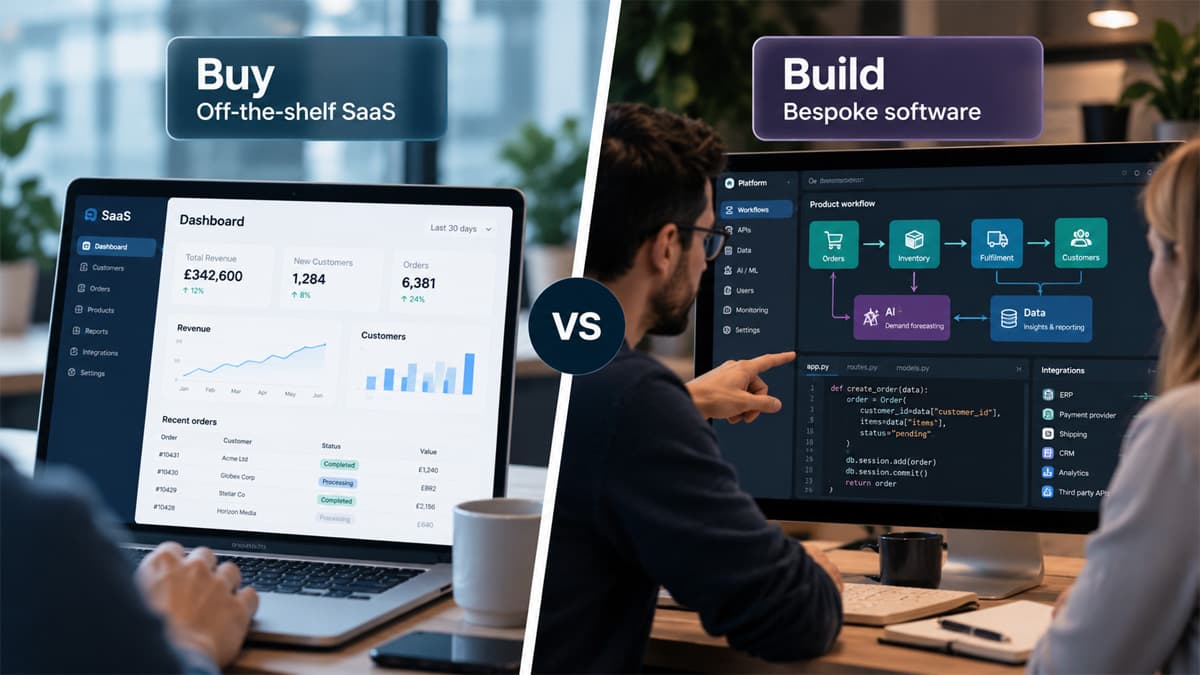
For many years, the received wisdom in enterprise technology was that if a business needed a new capability, the first question was usually: 'Can we buy it?'. Software as a Service (SaaS) matured, implementation cycles shortened, and the argument for OTS platforms became more persuasive. Inevitably, some level of customisation was needed to get OTS systems to work in the specific way that a business wants, hence 'customised-off-the-shelf' was where many businesses landed.
AI is entirely up-ending that conversation. In Private Equity and corporate growth, this shift is radically changing how we look at technology roadmaps and value creation.
Cutting code is one of the things that AI does best. Developers are increasingly acting as architects, prompt engineers and code reviewers whilst AI writes the code and automates QA and testing - amplifying productivity, compressing timelines and lowering the cost of custom bespoke software significantly.
In our software development business, Chilliapple, we are seeing a greater interest in building more capability in-house, or commissioning bespoke software that is tightly aligned to a company's specific processes, data, workflows and commercial model.
This is not a rejection of OTS software. Far from it. Good platforms still have an essential role to play. But AI has resurfaced a simple truth: competitive advantage rarely comes from using the same tools in the same way as everyone else.
The limits of standardisation and where it fails to fully harness AI transformation in businesses
Most established businesses run on an integrated eco-system of core platforms, specialist applications, spreadsheets, and human workarounds. That complexity is not always the result of poor decision-making. Often, it reflects the reality that every organisation has its own operating model, customer expectations, regulatory and compliance requirements, approaches and preferences of individuals in the organisation, and commercial pressures.
Traditional software procurement has often tried to simplify this by standardising processes around a chosen platform. That can work well where the process itself is not strategically important. Payroll, warehouse operations, basic finance and commodity CRM functions are obvious examples.
However, when software sits close to the customer experience, operational efficiency, pricing, fulfilment, marketing performance or data driven decision-making, the compromises become more visible. Businesses can end up bending important processes around the limitations of the software, rather than designing software around the outcomes they need.
AI makes that gap greater, because the value of AI depends heavily on context. A generic AI feature added to a platform may improve productivity at the edges. A well-designed AI capability embedded into a business-critical workflow can change the economics of the process entirely.
AI rewards businesses with well defined processes and good data quality
I always bang on about the importance of clear processes and procedures, and good data, which doesn't win me many friends at the pub :-), but has arguably become even more important now for businesses looking at AI transformation.
One of the misconceptions about AI is that it can simply be layered on top of existing systems and expected to deliver transformational results. In practice, AI is only as useful as the quality of the data, the clarity of the process and the strength of the surrounding software architecture.
This is where bespoke software development becomes particularly relevant. For AI to support decisions, automate tasks or augment teams, it needs access to the right data at the right point in the workflow. It also needs guardrails, the ability to be audited, and integration with the systems people already use.
As Sophie Spencer-Stephens, Managing Director of Chilliapple says:
'The most successful AI projects are not the ones that start with a model. They start with a business problem.'
'Where are skilled people spending time on repetitive decisions? Where are customers waiting unnecessarily? Where does valuable data exist but remain unused? Where does the business rely on manual judgement that could be supported, accelerated or made more consistent?'
Sophie Spencer-Stephens, Managing Director, Chilliapple
Once those questions are understood, AI becomes one component in a broader software solution, not a novelty bolted onto the side.
The return of strategic custom software
We should not confuse 'building bespoke software' with returning to slow, expensive, monolithic software projects. The modern version of bespoke development is different. Cloud infrastructure, APIs, CI/CD pipelines, low-code components, vibe coded prototypes, AI-assisted requirements capture and development, and mature engineering practices have changed what can be delivered, and how quickly.
The opportunity now is to build selectively. Businesses do not need to recreate everything. They should continue to buy commodity functionality where the market already provides strong solutions. But they should be far more deliberate about building the areas that differentiate them.
The advantage comes from combining proprietary organisational knowledge with well-designed software.
Governance is now part of the architecture
As AI becomes embedded in operational systems, governance can no longer be treated as an afterthought. Businesses need to know what data is being used, how outputs are generated, where human approval is required and how decisions are recorded.
This is another reason why mission-critical AI often benefits from custom design. Governance, security, permissions, audit trails and escalation routes need to reflect the real-world risk of the process. A marketing content assistant and an AI-supported credit decision workflow do not require the same controls.
The organisations that succeed with AI will not be those that adopt the most tools or throw the most money at providing expensive plans to employees. They will be those that design the right systems, with the right balance of automation, human oversight and commercial accountability.
A more deliberate future
The build versus buy debate is not binary. The answer is rarely one or the other. The smarter approach is to buy where software is standard, integrate where platforms are strong, and build where the process is distinctive, valuable or strategically important.
AI has made that distinction more important. It has also made bespoke software more powerful, because businesses can now create systems that do not just store information or move tasks from one queue to another. They can assist, recommend, predict and automate in ways that reflect the specific context of the organisation.
For business leaders reviewing their technology strategy, the question is no longer simply whether AI is included in the roadmap. The better question is: which parts of our business are too important to be shaped by generic software alone?
That is where the next generation of competitive advantage in software will be built.